
I’ve been writing about new year goals for quite a while now. I used to write about SMART goals pretty regularly at the beginning of the year – but those quickly became to Cognitive Behavioral for me. Too rigid.
Lately, in the past few years, I’ve been writing about WORDS. I honestly don’t remember where I read about this idea – it genuinely is NOT mine, but something I have been using. Rather than setting goals or declaring resolutions, I’ve been choosing a few words or goals for my year. NOTE:most “Resolutions” are dead, gone, done, KAPUT two weeks from today, statistically speaking. I keep those words handy, and try to adhere to them – as you see in th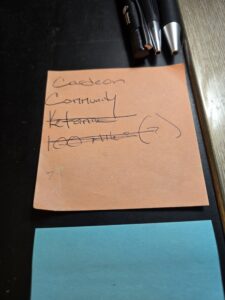 e photo below, they are on a post-it note, adhered to my desk. So they really do STICK. Get it… stick? Obviously, last year’s goal had nothing to do with written comedy…
I’ve also taken to drawing up a quick background using Canva to put in another place I see every day – my laptop screen. As you can see below, this year’s goals are similar, but a little different.
Last year, I successfully brought Ketamine Assisted Psychotherapy (KAP) to my office, and trained to ride my bike 100 miles in one day, and then did that. Our work at Cardeon continues to grow, and we are preparing for the next major update release by next month, and then to start moving in more focused directions with it. I failed to launch The Meaning Project Community last year. A combination of “lack of time” – which is a bad excuse, but an honest one as I remember completing 250+ hours of psychedelic assisted therapy training last year – but also fear. If I am honest, I am afraid to launch The Meaning Project Community. And that is exactly why it is the dominant goal this year.
From my assessment of last year, I get to see accomplishments and failures, and plan accordingly for this year. As you can see on my lock screen – The Meaning Project Community WILL launch by the end of February. It is mostly all recorded for the first edition – just a few edits to make, and then designing and loading it into the learning platform. From there, it is ready to go. Me – I always want to add more and bring it closer to what I think is “perfection”. But as Voltaire once said, “The Perfect is the enemy of The Good”… or, even more recently, author Seth Godin admonishes me to “JUST SHIP IT.”
My next  book is almost ready – just some editing and then the work of self publishing. I hope to have that out by summer. And then I have my personal goal of moving – mostly riding – 3000 miles next year. I originally had 4000, and then I started to look at that weekly breakdown and realized I was pushing insanity just a little.
So, how do you go about assessing last year – taking inventory of it, and then preparing for THIS NEW YEAR? Yes, the year has started already. But since most RESOLUTIONS are dead and gone by midmonth, maybe you’d be better if you took some time to really make sure this is what you want from the gift of this coming year.
As you think about it, I put a few resources together for you here:
1. Set Values-Based Goals
Instead of starting with what you want to achieve, begin with why it matters.
-
Ask: What kind of person do I want to be this year?
-
Tie goals to core values (e.g., health, family, creativity, service).
-
Example: Rather than “exercise more,” try “care for my body so I have energy for the people I love.”
Why it works: Values create intrinsic motivation and reduce burnout.
2. Use the “One Word” or Theme Approach
Choose a single word or short phrase to guide decisions all year (e.g., Presence, Courage, Simplify, Rebuild).
-
Let the word act as a compass rather than a checklist.
-
Evaluate opportunities by asking: Does this align with my word?
Why it works: It promotes coherence and flexibility instead of perfectionism.
3. Focus on Systems, Not Just Outcomes
Shift attention from end results to daily or weekly practices.
-
Outcome: “Write a book”
-
System: “Write for 20 minutes, 4 days a week”
-
Measure consistency, not just milestones.
Why it works: You control systems; outcomes follow.
4. Set Gentle, Tiered Goals
Create three levels for each goal:
-
Minimum (what’s realistic on hard days)
-
Target (your ideal baseline)
-
Stretch (ambitious but optional)
Example:
-
Minimum: Walk 5 minutes
-
Target: Walk 30 minutes
-
Stretch: Add strength training
Why it works: It reduces shame and keeps momentum during low-energy periods.
5. Include a Meaningful Reflection Goal
Add at least one goal focused on reflection, not productivity.
-
Journaling weekly
-
Monthly life review
-
End-of-day “What mattered today?” question
Why it works: Reflection integrates growth and prevents the year from passing unconsciously.
A closing thought
The most effective New Year goals don’t ask, “How can I do more?”
They ask, “What is worth doing—and worth becoming?”
Weekly Mental Health and Meaning Updates
Sign up below to receive weekly guidance from Dr. Dan.


