
This weekend didn’t go quite the way I had originally planned.
For months, I had expected to be in Frankenmuth, Michigan, riding in an MS charity cycling event with our team. Of course, my cycling accident earlier this summer changed those plans. I haven’t been able to train, and I’m certainly not ready to spend hours on a bicycle yet.
So my wife and I did the next best thing.
We volunteered.
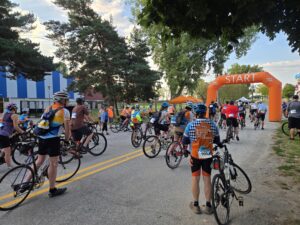

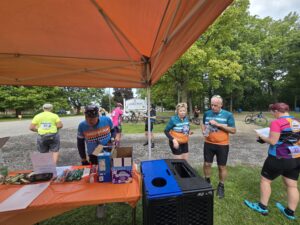
We spent part of the weekend working an aid station, handing out food and drinks, offering encouragement, and cheering on the riders as they came through.
And something unexpected happened.
Had I been riding, much of my attention probably would have been focused on our team, the road ahead, my pace, how my legs felt, and how many miles remained. Instead, standing on the side of the course gave me the opportunity to watch everyone.
Nearly 150 riders came through our aid station.
Different ages. Different abilities. Different teams. Different reasons for riding. Some looked strong. Some looked tired. Some stopped briefly and moved on. Others needed a little more time, a little more fuel, or perhaps a little more encouragement.
And standing there watching all of them, I found myself experiencing something psychologists have become increasingly interested in studying:
Awe.
We usually associate awe with extraordinary places. Standing at the edge of the Grand Canyon. Looking up at a sky filled with stars. Watching the ocean during a storm. Seeing a mountain for the first time.
But awe isn’t limited to nature.
We can also experience awe when we witness courage, generosity, beauty, sacrifice, music, faith, or people coming together for something larger than themselves.
One of the fascinating things about awe is that it seems to change our perspective. For a moment, our attention shifts away from ourselves. The endless internal conversation about our problems, responsibilities, frustrations, and worries becomes a little quieter.
Our problems don’t disappear.
They just aren’t the only thing we can see anymore.
Psychologists sometimes describe this as the experience of the “small self.” That doesn’t mean feeling insignificant or unimportant. Rather, we recognize that we’re part of something larger than ourselves.
I think Viktor Frankl would have appreciated that idea.
One of the central concepts in Logotherapy is self-transcendence—the idea that human beings often discover meaning by directing their attention beyond themselves toward someone we love, work that matters, a cause worth serving, or something meaningful in the world.
Frankl also wrote about experiential values: meaning we discover not by accomplishing something, but by experiencing something—love, beauty, nature, art, another human being.
Sometimes meaning isn’t something we create.
Sometimes we simply have to notice it.
That’s what happened to me this weekend.
I went to Frankenmuth disappointed that I couldn’t ride.
Instead, I got to stand on the side of the road and watch nearly 150 people ride past me in support of something larger than themselves.
I watched teammates encouraging one another. Volunteers giving their time. Riders pushing through fatigue. People laughing, struggling, celebrating, and continuing down the road.
And because I wasn’t where I had planned to be, I saw something I might otherwise have missed.
Maybe that’s part of the mental health value of awe.
We spend so much of our lives looking inward. How am I feeling? What do I need? What’s going wrong in my life? What am I worried about?
Those questions matter. Self-awareness matters.
But sometimes we need to look up.
Look at the night sky.
Listen to the music.
Watch the sunrise.
Stand beside the ocean.
Notice an extraordinary act of kindness.
Watch 150 people ride bicycles through Michigan to help people they’ve never met.
Let yourself be impressed.
Let yourself be moved.
Let yourself feel small for a moment—not because you don’t matter, but because you are reminded that you belong to something much larger than yourself.
So here’s my challenge for you this week:
Go find some awe.
You probably don’t need to travel very far.
Slow down long enough to notice something beautiful, courageous, generous, or extraordinary happening around you.
And when you find it, resist the temptation to photograph it, analyze it, or rush on to the next thing.
Just stand there for a moment.
And say, “Wow.”
Sometimes that’s good for the soul.
And, as it turns out, it may be pretty good for our mental health too.
Until next Monday,
Dr. Dan
Weekly Mental Health and Meaning Updates
Sign up below to receive weekly guidance from Dr. Dan.


